
On 10 June, at the bootcamp, we worked through the method of inventive thinking. This page is your working hub for the summer: topics, a step-by-step roadmap, resources, videos and deadlines. Come back to it at every stage of the project.
SEASON 2026 · Samsung Solve for Tomorrow
Solve for Tomorrow 2026
A summer with a project — from researching the problem to uploading the presentation
Season completed
⚠️ Machine translation, not yet reviewed by a native speaker. The Russian version of the page is the source.
Season photos


Season film
 ▶
▶The Solve for Tomorrow 2026 final — 36 inventions by school students
Season six is over: 38 semi-finalist teams defended their prototypes before the jury.
Season results
25 August
Final
alem.ai
Venue
11 teams
In the final
10 million ₸
Prize fund
858
Applications this season
2,800
Participants
38 teams
Semi-finalists
Season projects
🥇1st place· MKGA · Aktobe
OquBot — an educational robot with block programming
An engineering kit with its own environment: the child assembles the robot by hand, programs it in blocks, and the code is translated instantly into C++ and Python. Three iterations followed the tests — the case material was changed and the model reworked after the first version bored the children. Trialled in five learning centres in Aktobe with 75 students.
▶ watch the pitch🥈2nd place· Endosim · Turkistan
Endosim — a simulator for teaching endoscopy
A silicone model with pressure and vibration sensors: the student practises a colonoscopy while the system reports where the mucosa was damaged and how abrupt the movements were. The methodological basis is the method of the chair of the Kazakhstani endoscopists' association, used under an agreement. It costs 261,000 tenge to make, against imported simulators.
▶ watch the pitch🥉3rd place· Asian Sharks · Karaganda
SAMRUQ.AI — predictive safety for mines
A network of underground sensors, a surface gateway and a dispatcher's dashboard: the system does not record an accident after the fact, it warns tens of minutes ahead. Counting people underground takes seconds instead of tens of minutes and needs no chips in the helmets. A mobile robot was dropped after talking to miners — it kept losing the connection.
▶ watch the pitch🏅finalist· TN-BIONICS · Astana
TN-Bionics — an exoskeleton for children with cerebral palsy
A robotic exoskeleton that controls the angles of the hip, knee and ankle joints. An app tracks progress step by step and AI measures the angles from video — not replacing the doctor but giving them data. The focus on children is deliberate: a child's loads and proportions are different.
▶ watch the pitch🏅finalist· sNiba · Oral
OcuWave — early diagnosis of glaucoma
A compact device for primary screening: gentle contact with the eyelid, a weak impulse, and a Hall sensor reads the rebound. Designed for villages with no ophthalmologist — a nurse takes the measurement and a doctor diagnoses remotely. Piloted in Oral and at a city polyclinic.
▶ watch the pitch🏅finalist· Tenzo · Astana
Tenzo — a cable-driven exoskeleton for the arm
The electronics and mechanics are moved off the arm onto cables — hence the light weight and the fit to any patient without separate sizes. Electromyography sensors read muscle activity. The scenario: first in the clinic with a rehabilitation specialist, then at home if the doctor agrees.
▶ watch the pitch🏅finalist· Orchid · Almaty
FLORTTE — a training glove for children with coordination disorders
A glove with five sensors and an app where exercises are performed in time to music: a movement counts only if it lands on the beat. Two pilots at a special-needs school produced an unexpected conclusion — the plastic glove was replaced with a fabric one, as the plastic distracted the children from the game.
▶ watch the pitch🏅finalist· BraceMotion · Shymkent
BraceMotion — a bracelet for people with tremor
A wearable device against tremor in Parkinson's disease. Three prototype versions: the case became more compact, the vibration more noticeable, and a gyroscope and monitoring app were added. As the team puts it, tremor takes away not movement but independence in daily life.
▶ watch the pitch🏅finalist· Serpin · Arys
SOS Serpin — first aid where there is no doctor
An app for rural districts: calling for help, the nearest point of care, a history of requests and a learning section on what to do before the ambulance arrives. The key requirement, drawn from the place itself: it must work without a stable connection.
▶ watch the pitch🏅finalist· OnAITynys · Kokshetau
OnAITynys — night-time breathing monitoring for children with asthma
The device attaches at the solar plexus and reads five parameters, including blood oxygen, pulse and breathing rate. The team arrived at the mentoring session with a finished prototype and admitted they had not accounted for users' needs — after 13 interviews at a hospital they turned their way of working around.
▶ watch the pitch🏅finalist· XLNC Astra · Astana
SAPIENS — a robot for documenting caves
Two configurations: a narrow 14 cm one for tight passages and a stable one for scanning. Omnidirectional wheels let it move without turning, while lidar and a smart camera build the map. The AI model was trained on 1,200 of the team's own images, gathered together with speleologists of the Karaganda region.
▶ watch the pitchBootcamp topics
Method
Our own: design thinking + product + business model + TRIZ. An inventor is a role, not a talent.
Design thinking
Observe → Focus → Ideas → Prototype → Test. The frame for the whole project.
Systems description
A canvas: problem · solution · who · how it works · context of use.
Jobs to be Done
What job is the user hiring your project to do?
Interviews
With users and with experts. Summer is the time to improve the prototype on what they tell you.
TRIZ
Resolving contradictions: how to get both things without a compromise.
Prototype
Software + hardware + form factor. From a paper mock-up to a working version.
A business view
Who values it, how it is put together, how it could live on.
Stakeholders
A stakeholder map plus a table of what partners gain.
Outreach
How to write to an expert or a partner and actually get a reply (message templates).
Presentation
Structure by template plus how to tell your project in three minutes.
The summer roadmap in detail
6 stops — from researching the problem to uploading the presentation.
01
Researching the problem
- —The scale of the problem: who it affects and how
- —Statistics and expert opinion on the problem
- —What already exists in the country and why it does not solve everything
- —Field research: observation, interviews, surveys
- —Helps: a stakeholder map plus a table of what partners gain
02
Solution and benefit
- —How the project solves the problem — the benefit in qualitative and quantitative terms
- —Helps: the design-thinking algorithm
03
Prototype and context
- —What the prototype is made of: software (front/back) · hardware (chip, sensors, controllers, power) · form factor
- —Scenarios: where (city/indoors/outdoors) · who (customer/user) · when (24×7, seasonal, time of day)
- —What could go wrong? Heat, frost, dust, damp, animals
- —Who might break, hack or steal it — deliberately or not. How do you reduce that?
04
Building and testing
- —First version: a low-fidelity prototype (paper/mock-up) → a high-fidelity one (software, hardware, mechanics)
- —User interviews — in person, by phone, on a call, in chat
- —Expert interviews — someone from the profession who knows the problem
- —Testing in the field, with a user, with an expert
💡 Photograph and film your testing and interviews — you will need that material for the final presentation.
05
Refining
- —The prototype: specifications, code, the quality of the form factor (cardboard became PVC)
- —Updating the use scenarios and the project's evolution
- —A view from every side using SWOT
06
Presentation and upload
- —Structure — follow the presentation template provided
- —Check what you filled in — against the presentation checklist
- —Cross-check with the systems-description canvas (nothing forgotten?)
- —Deadline — 30.07.2026 by 23:59, in your account on solvefortomorrow.kz
Advice
Do not leave the paperwork to the end
The project and the presentation are not last-minute work: gather your material as the summer goes.
Testing is the heart of the project
Live feedback from users and experts is exactly what sets a strong project apart at the August selection.
Ask questions
Of mentors, of experts, of each other. Asking is normal and useful.
These are skills for life
Everything you master on the project will serve you in study, at work and in your own ventures.
🧰 Resources and templates
🤖A prompt library for AI ↗Ready-made prompts for every stage of the project🏢A register of Kazakhstani companies ↗100 organisations — who to write to for expertise📅The mentoring session schedule ↗Google Sheets — put your team into a slot that suits you🎯The final presentation template ↗Google Slides — the structure of a pitch🎤A checklist for speakers ↗Notion — preparing your talk✅The presentation checklist ↗Google Sheets — a self-check before the defence
🎥 Guest speaker recordings


🚀 Future innovators
A platform for the stories of Kazakhstan's young inventors, grown out of Solve for Tomorrow. We collect the stories of teams solving real problems through technology — to show them and to inspire the next generation of innovators.
Tell your story →Deadline and upload
WhereYour account on solvefortomorrow.kz
Whenby 30.07.2026, 23:59
Presentation*.ppt, *.pptx or *.pdf
Videoon YouTube, with the link in the presentation and the covering text; three minutes or less is recommended
Inspiration — projects from past years
Pitches from past seasons: how to explain a problem in three minutes, show the prototype at work and present the test results.
 ▶Capturing CO₂ and converting it into calcium carbonate
 ▶A game that raises awareness of air pollution
 ▶A range of devices for people with low vision
 ▶A bioprinter for artificial skin to treat wounds
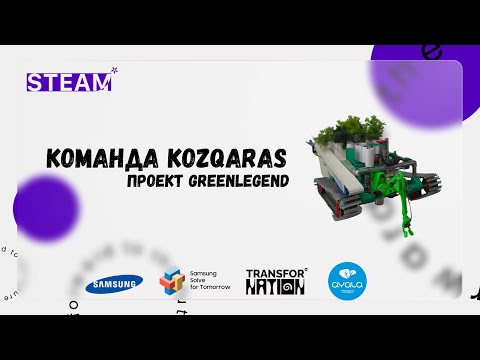 ▶An autonomous robot that plants seedlings in deforested areas
 ▶A robot for spot-spraying pests and weeds
 ▶Controlling a wheelchair and other technology with the tongue and gestures
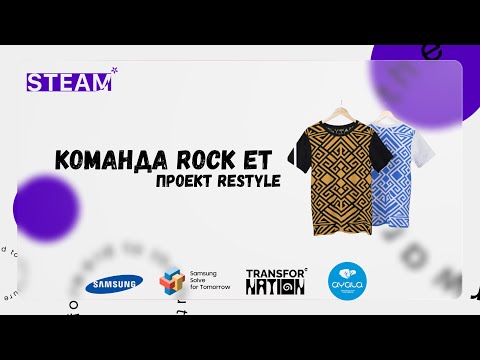 ▶Clothing in national style made from recycled plastic
 ▶Alerting deaf people to everyday sounds
 ▶A powered wheelchair that climbs stairs and obstacles
 ▶A device plus an app to make communication easier
 ▶Software for learning and communication for people with ASD
 ▶A device that improves communication for deaf and mute people
 ▶Ability to Refine
 ▶Educational programmes that build professional skills in children
 ▶A mushroom box for breaking down polyurethane
 ▶Testing water for microorganisms and pathogens
 ▶A smart incubator for germinating seeds
 ▶A firefighting robot for hard-to-reach places
 ▶Sand legionnairs
 ▶Vision Assistant
 ▶Full Speed Wheelchair
 ▶Early diagnosis of ASD plus support for parents
 ▶An eco stimulant of plant growth for better yields
 ▶An app plus a prototype against poor posture
 ▶Irrigation efficiency with sensors and data analysis
 ▶IoT + AI + computer vision for agricultural automation
 ▶Smart buoys for safety and monitoring
Press and social media
- 2026-03-11 · Samsung Newsroom КазахстанSamsung объявляет о старте конкурса стартапов для школьников Solve For Tomorrow 2026 ↗
- 2026-03-11 · Samsung Newsroom Казахстан (KZ)Samsung мектеп оқушыларына арналған Solve For Tomorrow 2026 стартап байқауының басталғандығы туралы хабарлайды ↗
- 2026-03-16 · Profit.kzSamsung объявил о старте конкурса Solve For Tomorrow 2026 ↗
- Astana HubSamsung announces launch of startup competition for schoolchildren Solve For Tomorrow 2026 ↗
- 2026-06-12 · Samsung Newsroom КазахстанДизайн-мышление для школьников: как прошла ментор-сессия Solve For Tomorrow 2026 в Астане ↗
- 2026-06-12 · Samsung Newsroom Казахстан (KZ)Мектеп оқушыларына арналған ойлау дизайны: Solve For Tomorrow 2026 ментор-сессиясы Астанада қалай өтті ↗
- 2026-07-17 · Astana HubЮные новаторы ВКО покоряют республиканский конкурс стартапов «Solve for Tomorrow» ↗
- 2026-08-31 · Samsung Newsroom КазахстанФинал конкурса школьных стартапов Solve For Tomorrow 2026 прошёл в Астане ↗
- 2026-08-31 · Inbusiness.kzФинал конкурса школьных стартапов Solve For Tomorrow 2026 прошёл в Астане ↗
Social accounts of organisers and partners
- 2026-04-10 · Ayala FoundationApplications open for the 2026 season ↗
- 2026-04-10 · TransforNATIONAn invitation to the season: the first step towards your own startup ↗
- 2026-04-14 · Samsung KazakhstanSamsung invites school students to Solve for Tomorrow 2026 ↗
- 2026-06-29 · Ayala FoundationYear six of the programme: a chance to learn, to try and to build ↗
- 2026-08-20 · Ayala FoundationAnnouncing the final at alem.ai ↗
- 2026-08-24 · TransforNATIONThe final of season six: eleven teams at Alem.AI ↗
- 2026-08-27 · TransforNATIONThe 2026 final: eleven of the strongest teams from across the country ↗
- 2026-08-27 · TransforNATIONThe TN-Bionics team on the final ↗
- 2026-08-27 · TransforNATIONThe MKGA team on the final ↗
- 2026-08-27 · TransforNATIONThe xCellence team on the final ↗
- 2026-08-31 · TransforNATIONResults of the final at alem.ai ↗
- 2026-09-07 · Ayala FoundationSolve for Tomorrow — an educational initiative for young leaders ↗
Season news

25 August 2026
Финал Samsung Solve for Tomorrow 2026: одиннадцать команд, три призёра и одно наблюдение
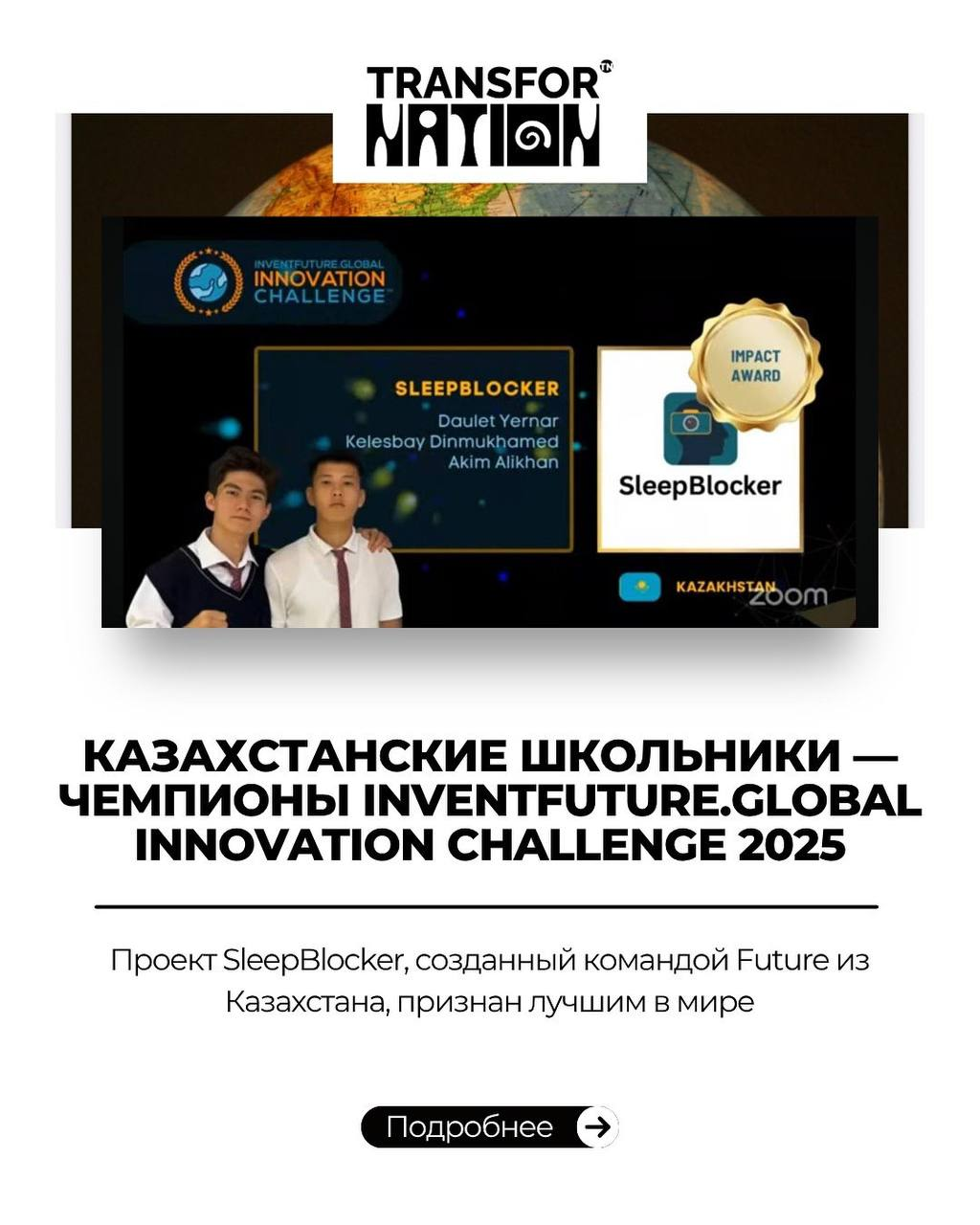
9 November 2025
Двойной триумф на InventFuture.Global Innovation Challenge 2025! 🇰🇿🥇
23 October 2025
Казахстанская команда Future — в числе глобальных финалистов InventFuture.Global Innovation Challenge 2025!
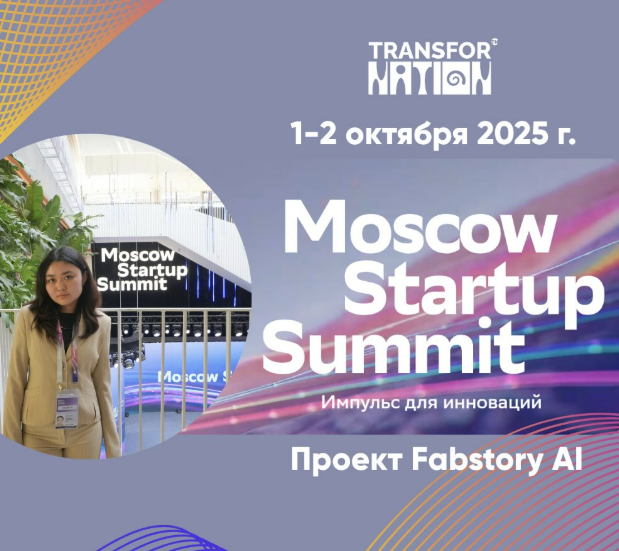
10 October 2025
Казахстанский стартап Fabstory AI покоряет Москву и международный рынок MedTech
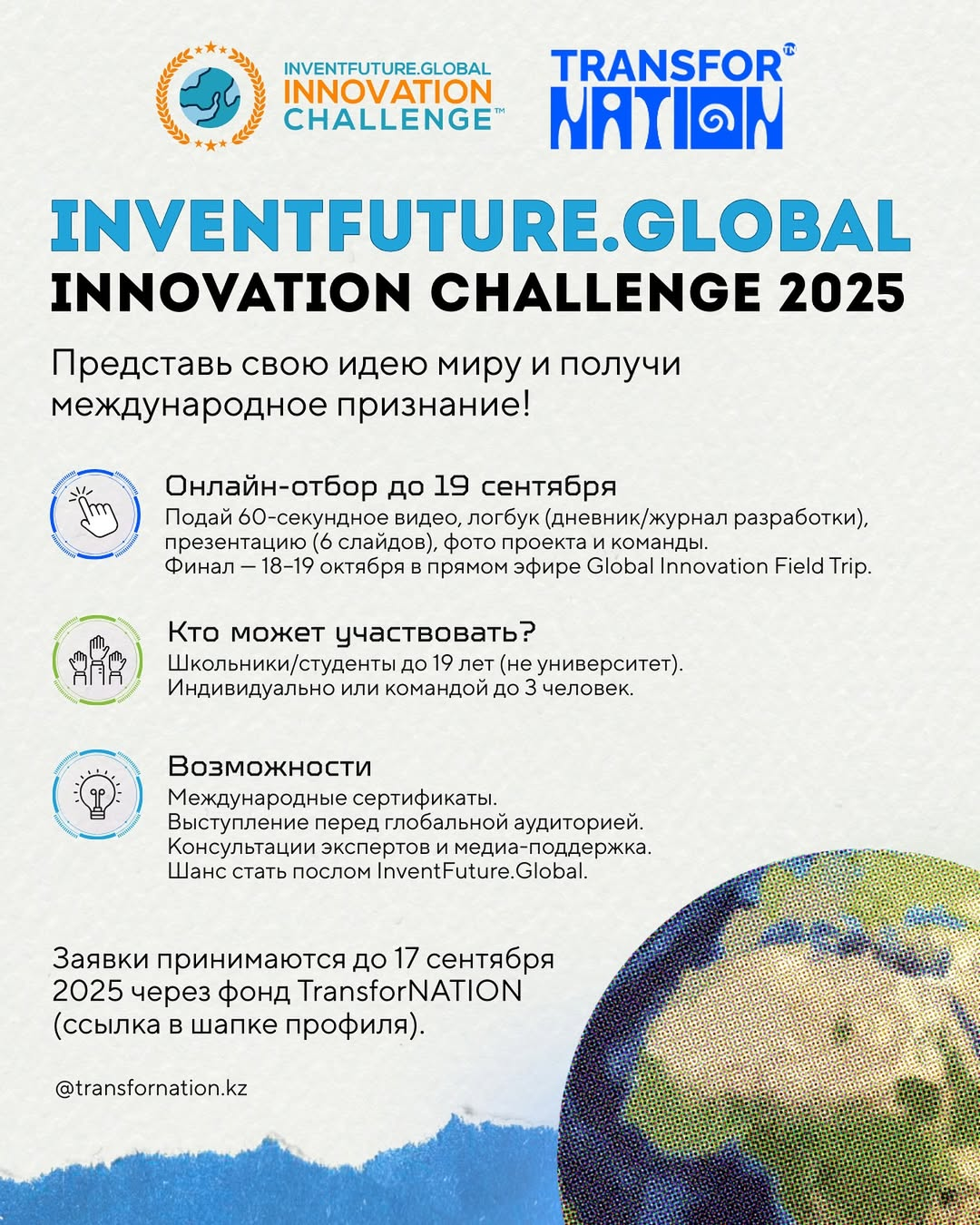
7 September 2025
InventFuture.Global Innovation Challenge 2025
29 June 2025